
How to avoid a Tanzania safari scam: the real checks to run before you pay, from an operator who’s been targeted too. Read before you book.
Traveling in September or October?
Introduction
A few years ago, someone worked their way through a full booking conversation with us, pretending to be a client. Something didn’t add up partway through, so we kept the conversation going deliberately, on our own terms, until the person exposed themselves trying to complete a booking under a different identity. We got the police involved. Separately, one compromised staff email once put us one careless click away from a client’s payment going to the wrong company entirely. Neither cost a client anything, and we’ve tightened things considerably since, but we’re not going to pretend a company our size is untouchable. That’s exactly why the checklist below isn’t theory. It’s what would have actually caught both attempts, and what will catch someone trying it on any operator, including us.
Comparing us against another operator you’re considering? Talk to our team — we’re happy to be checked.
The Checklist
Twelve checks, in the order that actually matters. The first few confirm you’re safely talking to the real company right now. The rest confirm the company itself is genuinely licensed and established. Both matter, and as our own story above shows, passing one doesn’t guarantee the other.
1. Check the email domain, character by character. Ours is goshenisafaris.com. We’ve seen lookalikes with an added dash (gosheni-safaris.com) and an extra country extension (goshenisafaris.it.com) — both pass a casual glance if you’re not looking closely.
2. Get a second, independent contact channel early. If you started by email, ask for a WhatsApp number too, or the other way around. A scammer who’s compromised one channel almost certainly doesn’t control a separate one. If someone resists giving you a second way to reach them once you’re several questions into planning, notice that.
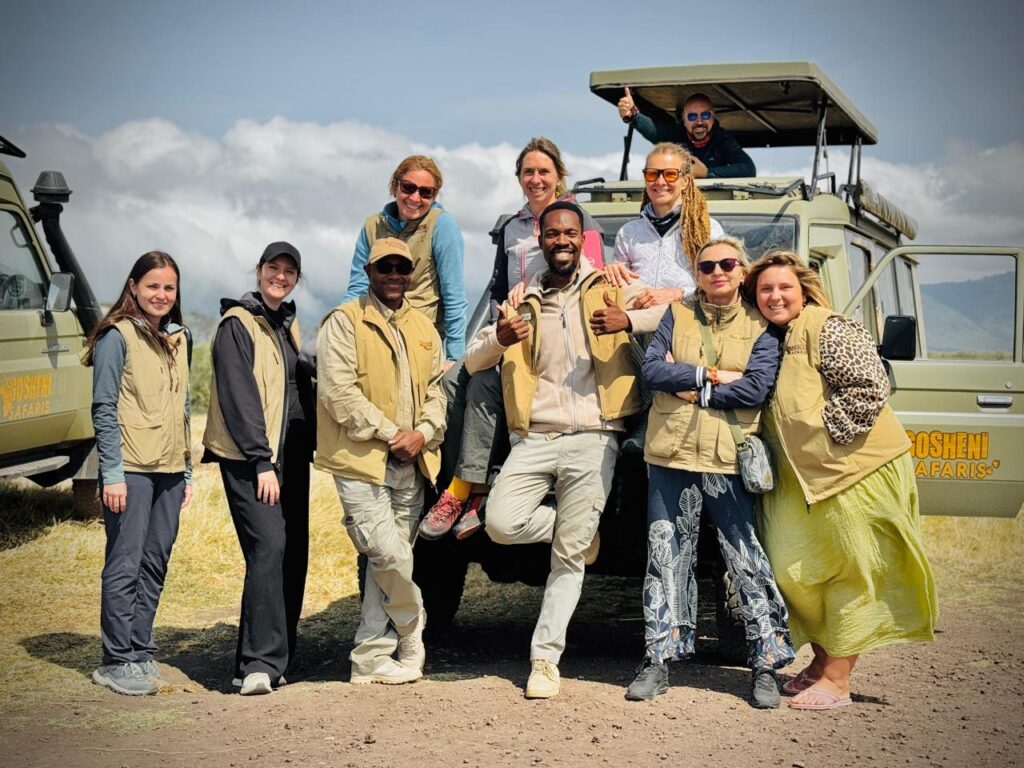
3. If you want full certainty, ask for a video consultation. See the person, get their name, and cross-check it against the management team listed on our About page. We haven’t had a client take it this far, but we’d genuinely welcome it. This isn’t a small purchase — it’s money you’ve saved for a trip that matters, and you deserve to feel certain where it’s going before you send it.
4. Verify TALA and TATO directly, not just the badge. TALA (the Tanzania Tourist Agents Licensing Authority) issues the actual government tour operator license. TATO (the Tanzania Association of Tour Operators) is industry membership — a strong additional signal, though not itself the government license. A real operator gives you both numbers without hesitation, often before you ask. Check them against the official listings yourself rather than trusting a logo.
5. Confirm the business name matches exactly who you’re transferring money to. It should be a company name, never a private individual. If anyone tells you their company account “has issues” and asks you to transfer to a personal name instead, that’s not an inconvenience — it’s a hard stop.
6. Confirm a written cancellation policy and a real booking contract exist. Not a verbal assurance, not just an email thread or a WhatsApp confirmation — an actual document.
7. Check reviews for specific detail. Real guide names, camp names, and dates, not just star ratings. A wall of five-star reviews posted the same week is worth a second look.
8. Check social media for a consistent, multi-year history. Real vehicles under the company’s name, real guides, real clients across different trips and seasons. One staged photoshoot is possible to fake. Years of it, with different people, is not. This confirms the company is genuinely established — though it doesn’t confirm you’re safely talking to them today, which is why checks 1 through 3 come first.
9. Ask for company documents — a tax certificate, business registration. These can, in theory, be forged. But asking still does something useful: a scammer working fast across many targets generally won’t bother producing convincing paperwork for one person. It’s not proof on its own, but it adds friction, and a real company hands it over without hesitation because they have nothing to hide.
10. Run the price test. Park fees, guides, vehicles, and fuel have a real floor cost. Kilimanjaro park fees alone run close to $70 per person per day, and a Serengeti or Ngorongoro safari carries similar fixed costs before anything else is added. A quote 40 to 50% below what other operators charge for the same itinerary isn’t a deal — it’s a sign something in that price isn’t real.
11. Know the local patterns. Around Arusha specifically, watch for fake safari booking pages and social ads targeting searches like “cheap Serengeti tours,” counterfeit park fee receipts sold near park gates, and last-minute “discount safari” approaches at the airport or in town, often with photocopied licenses. None of these are sophisticated. They rely on urgency and on travelers not knowing what a real license or receipt looks like.
12. Understand what booking direct actually trades off. An EU-based agency bonded under a national guarantee scheme, like Denmark’s Rejsegarantifonden, gives you insurance-backed protection if something goes wrong — built into their margin, partly to cover that bonding and EU-based overhead. Booking direct with a Tanzania-based operator means no added agency layer, your payment goes straight to the company running your safari, but you’re outside that specific EU guarantee scheme, regardless of how established the operator is. Checks 1 through 11 are what close that gap when you choose to book direct.
None of these checks alone is unbeatable — a good enough forgery could pass any single one. What a scammer generally can’t sustain is all twelve at once, across a real conversation, a second channel, and paperwork, without slipping somewhere.
When This Is a Yes / When This Is a No
This is a yes if the TALA and TATO numbers check out independently, the business name matches exactly who you’re paying, you have two separate ways to reach a named person, and the company has a multi-year, consistent social media and review history.
This is a no if any credential can’t be independently verified, if you’re asked to pay a private individual instead of a company account, if a second contact channel is refused once you’re deep into planning, or if the price is dramatically below what others quote for the same itinerary.
We Get This Question a Lot
Is it actually riskier to pay a company based outside the EU? In one specific way, yes — you’re outside EU-based guarantee schemes like Rejsegarantifonden, and that’s worth being honest about. In every other way, the risk comes down to the same checks above, regardless of which country the company is registered in.
Doesn’t an article like this make people trust the industry less? We’d rather you go in informed than find out the hard way. Every check on this list is one a legitimate operator, including us, should be glad to pass.
Conclusion
Verifying a Tanzania safari operator takes about ten minutes once you know what to check, and most operators who can’t be verified fail at least one of these points immediately. This isn’t about being suspicious of everyone — it’s about protecting money you’ve worked hard to save, for a trip you shouldn’t have to worry about once you’re actually on it.
Ready to Book With Confidence?
Check us against every point above, and if you have questions about anything, we’re happy to walk through it with you before you send a single euro.