
You’ve probably heard the words “Great Migration” before you ever thought about booking a trip – and there are usually two reasons for that. Either you actually know your facts, the kind of person who reads about ecosystems and migratory behavior for its own sake, or you’ve picked it up secondhand, from other travelers repeating the same hype they themselves heard from someone else before they’d ever seen it. Both groups end up booking the same trip, but with very different expectations of what they’re actually going to get.
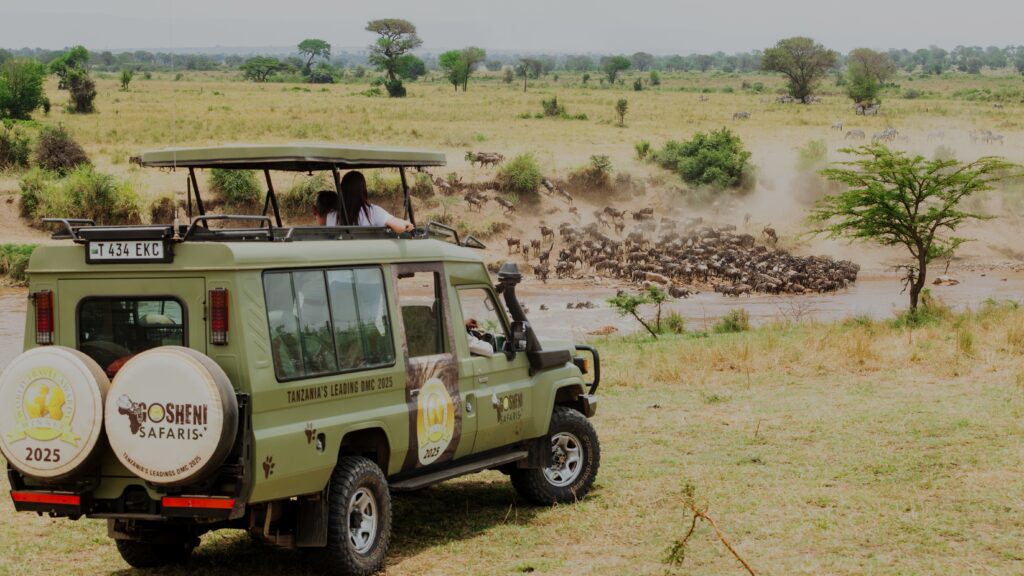
So let me back up and explain it properly – as someone who travels for a living first, and a Tanzania specialist second. I’ve sat at the Mara River for almost four hours once, waiting for a crossing that never came. The wildebeest gathered at the bank, paced, turned back, gathered again – and then the light started to go, and we drove back to camp with nothing. The next morning, less than a kilometer downstream, over a thousand of them crossed in eleven minutes flat. That’s the actual texture of this thing. Not a show that starts on schedule. A live, ongoing event you either get lucky with or you don’t.
Traveling in September or October?
What the Great Migration Actually Is
More than 1.5 million wildebeest, along with several hundred thousand zebra and gazelle, move through the Serengeti-Mara ecosystem in a continuous loop, following rainfall and grazing. It’s been happening for over a million years, long before anyone was here to watch it.
It is not an event with a start and end date. It does not pause. Calling it “migration season” is a little misleading – there’s no season where it stops, only seasons where a specific part of it happens in a specific place:
- January to March – the herds are calving on the southern plains, mostly around Ndutu.
- April to June – they move north and west through the central Serengeti and the Grumeti area.
- July to October – they push into the north, crossing the Mara River, sometimes into Kenya, often back and forth across it more than once.
- November to December – they turn south again as the short rains arrive.
Each animal covers around 800 kilometers over the full cycle, even though the most direct route is closer to 500. They double back, split into separate herds, and don’t move as one synchronized mass. A crossing isn’t one clean event – it’s hundreds of individual, almost accidental decisions, where one animal jumps and the rest either follow or don’t.
“But Is It Guaranteed?”
We get this question a lot, and the honest answer is no – and I’d rather tell you that now than have you find out on day three of your safari.
Nobody can guarantee a river crossing on a specific day, including the wildebeest themselves. They gather at the riverbank, hesitate, sometimes for hours, sometimes for days, and the decision to actually cross can be triggered by something as small as one animal losing patience first. An operator who promises you a crossing on a fixed date is promising something nature doesn’t cooperate with.
What we can control is positioning – putting you in the right area, at the right time of year, with a guide who knows the current crossing points rather than just the general region. That improves your odds significantly. It doesn’t make it a guarantee.
This Is Where Your Guide Actually Matters
I’d take this seriously, because it’s one of the few parts of this trip you actually have control over, and it’s also the part people cut corners on most easily without realizing it.
A guide who’s been tracking this specific migration for years knows things that don’t show up in any guidebook – which side of a crossing point the herd tends to gather on a given week, how recent rainfall has shifted the grazing, which radio contacts among other guides are reliable that day. That knowledge is the difference between sitting at the right spot and sitting at a spot that was right last week.
There’s also a logistics side to this that’s easy to underestimate. Because the migration follows a predictable rough calendar even if the exact days don’t, the camps and lodges closest to the calving grounds and crossing points book out months in advance – sometimes a year, for the most in-demand weeks in August. A reliable operator secures that positioning early. A cheaper one, working with whatever’s still available by the time they get around to booking, can end up putting you in a lodge two or three hours’ drive from where the actual action is that week – which on a tight schedule, can mean you spend more time in transit than at the river.
Here’s a real version of how that goes wrong: a traveler books a budget migration safari for late August, expecting Mara River crossings. The operator hasn’t secured anything close to the river months out, because they were working with leftover inventory. By the time the trip is confirmed, the only available camp is well south of the action, near Seronera. The guide is competent but isn’t specifically tracking that week’s crossing activity, because that’s not the route they normally run. The traveler spends three of their five days driving back and forth, sees wildebeest, but never gets near an actual crossing – and has no way of knowing, until they’re already there, that a different operator with the same budget could have positioned them an hour from where it was actually happening.
Why Tanzania Specifically, Not Kenya
This is probably the most useful thing I can tell you before you book anything, because most people assume Kenya’s Maasai Mara is where “the migration” happens, and that’s not quite right.
The Serengeti-Mara ecosystem is genuinely one ecosystem split by a border the animals don’t recognize. But the math isn’t equal: roughly 97% of that ecosystem’s land area is the Serengeti, in Tanzania. Only about 3% is the Maasai Mara, in Kenya. The herds spend the overwhelming majority of the year on the Tanzanian side. Kenya only sees a meaningful share of the herd for around three to four months, from roughly July to October, and even then, less than half the wildebeest actually cross over. The rest stay in the northern Serengeti.
The river crossings themselves are also more available on the Tanzanian side than people expect. The Mara River runs mostly through Tanzanian territory before it ever reaches the Kenyan border, and crossings happen at multiple points along it – not only when wildebeest cross from Tanzania into Kenya, but also when they cross back and forth within Tanzania itself, or within Kenya, depending on where the grazing looks better that week. Tanzania also tends to have fewer vehicles per crossing point, simply because the Maasai Mara is a smaller reserve and draws a concentrated crowd into a tighter space.
None of this means Kenya is a bad choice – the Maasai Mara is real, dramatic, and worth visiting. But if your actual goal is the migration specifically, Tanzania gives you more months of access to it, more crossing points, and fewer people standing between you and the view.
If your interest is general Big Five wildlife in a natural habitat rather than the migration specifically, South Africa’s private reserves (the Kruger area, for example) can actually serve that goal better – higher sighting reliability for lion, leopard, and rhino in a shorter time, often with less driving between sightings. That’s a different kind of trip, built around guaranteed density rather than following a moving, unpredictable event. If what draws you is the scale and unpredictability of an actual migration, Tanzania is where that happens. If what draws you is reliably seeing the Big Five without chasing a moving target, that’s a fair reason to look elsewhere.
What Nobody Tells You Going In
Roughly a quarter of a million wildebeest and around 30,000 zebra die during the migration cycle each year – from predation, drowning, exhaustion, or thirst – which gives you a sense of how chaotic and undirected the actual event is.
A few other honest things worth knowing:
- During the busiest crossing weeks, usually late July through August, popular viewing spots on the northern Mara River can get crowded with vehicles. It’s not chaos, but it’s not solitude either.
- The days between crossings can involve long stretches of driving and waiting, which isn’t for everyone.
- Calving season in the south is quieter and less crowded, but also less dramatic if a crossing specifically is what you came for.
What You Get Even Without a Crossing
This is the part that actually convinces me it’s worth it, more than any single crossing photo. The migration corridor is also where predators concentrate, because that’s where the food is. Calving season specifically draws intense lion, cheetah, and hyena activity, since newborn calves are vulnerable in their first weeks of life. You’re far more likely to see real predator behavior – a hunt, a kill, a standoff – during migration months than during a quiet dry-season drive somewhere else in Tanzania.
So even on a day with no crossing, you’re usually still watching something genuinely active happen, not animals standing still in a field.
When This Is a Yes
This is genuinely worth planning around if:
- You have at least 5 to 7 days to dedicate to the migration specifically, not squeezed into a shorter general safari
- You’re drawn to wildlife behavior and ecosystems, not just checking off a sighting
- You can hold loose expectations about whether you’ll see a crossing, and still feel the trip was worth it either way
- You’re interested in predator activity – this is genuinely one of the best windows in Africa to see it
When This Is a No
I’d actually steer you elsewhere if:
- You have 3 days or less and want to maximize guaranteed wildlife density – Ngorongoro Crater will give you more reliable sightings in less time
- A river crossing is the one thing you’re hoping to see, and you wouldn’t feel the trip was worth it without one
- You’re traveling with very young children and limited patience for long waiting periods in a vehicle
- Your budget only stretches to a shorter trip, and you’d rather spend those days somewhere with a more predictable payoff
This isn’t a once-in-a-lifetime thing you do and check off. If wildlife behavior and ecosystems are genuinely something you care about, this is something you come back to – different season, different part of the herd, a different experience every time. It rewards return visits more than first-timers usually expect.
Is It Worth It With Kids?
Since family travel came up in the “when this is a no” list above, it’s worth a closer look on its own, because the honest answer depends on ages and on which part of the migration you’re aiming for.
Calving season tends to work better with children than river-crossing season. The pace is gentler, predator action happens close to camp rather than after long drives, and there’s no single event you’re either catching or missing – which takes the pressure off.
River-crossing season can work well with older children who can handle long game drives and some waiting, but I’d be cautious with very young kids. The hours spent waiting at a crossing point can be a lot to ask of a five-year-old, and there’s a real chance the wait won’t pay off with a crossing at all.
I’ll be honest about where I land on this myself. My kids are 6, 4, and 2 right now, and I wouldn’t bring them on a river-crossing safari at this age – it’s too much sitting and waiting for what they’d actually get out of it, and that kind of stress isn’t worth it to me as a parent. My Danish husband would probably feel differently about it. Danish parenting tends to be pretty relaxed about kids sitting through boredom or discomfort – it’s normal here for small children to spend hours outside in all weather, and a long wait at a riverbank wouldn’t register as a problem to him the way it does to me. He’d likely see the waiting itself as part of the experience, not something to avoid. It’s a genuine difference in how we each weigh “worth it,” and I think that’s true for a lot of parents deciding on this, not just us.
The Honest Verdict
If you have the time and the right expectations, yes – it’s worth it, not because of any single dramatic moment, but because of the density and honesty of wildlife behavior you get to witness across days, not minutes. If you’re working with a short trip and a fixed idea of exactly what you need to see, there are other parts of Tanzania, or other countries, that will serve you better.